Crow & Co, turning India’s forgotten folktales into riddles worth sharing
Design Days · Relationship Design Challenge ’26 · Team Eenampechi · NID Bengaluru

Intro
Of 25 students we spoke to, 17 knew the Greek myth of Sisyphus. Only one could tell the story of Naranathu Bhranthan, Kerala’s own man with a stone and a hill.
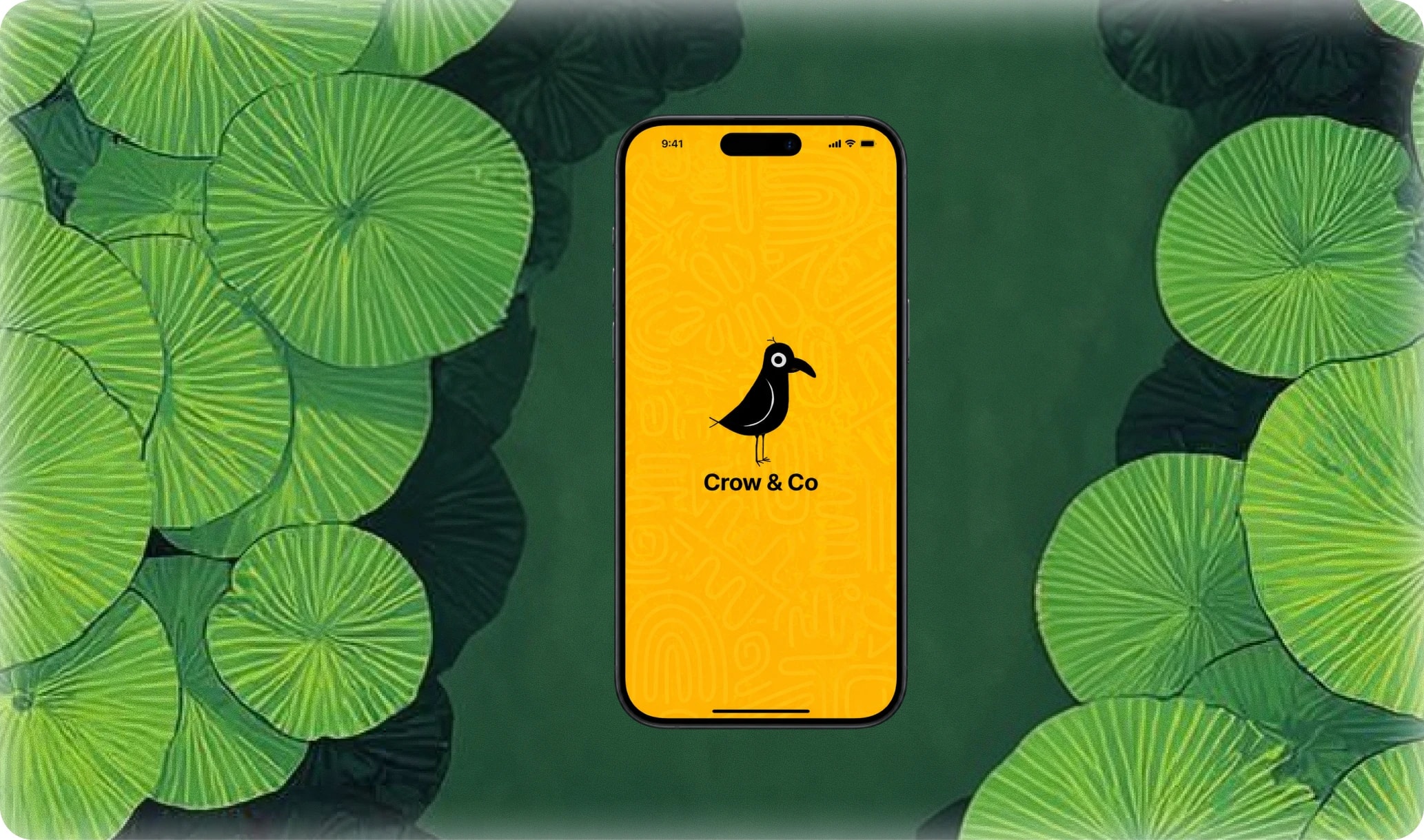
Crow & Co is a lateral-thinking riddle game built from India’s regional folktales. Players solve a story together, an AI crow guides them with hints, and the group’s best guesses become a short shareable film. We designed it for the Design Days Relationship Design Challenge ’26 to give fading stories a reason to be retold.
- Timeline
- Sept – Oct 2026
- Team
- Anjali Vishnu
- Akhil Cleatus
- Context
- Design Days · Relationship Design Challenge ’26
- Tools
- Figma
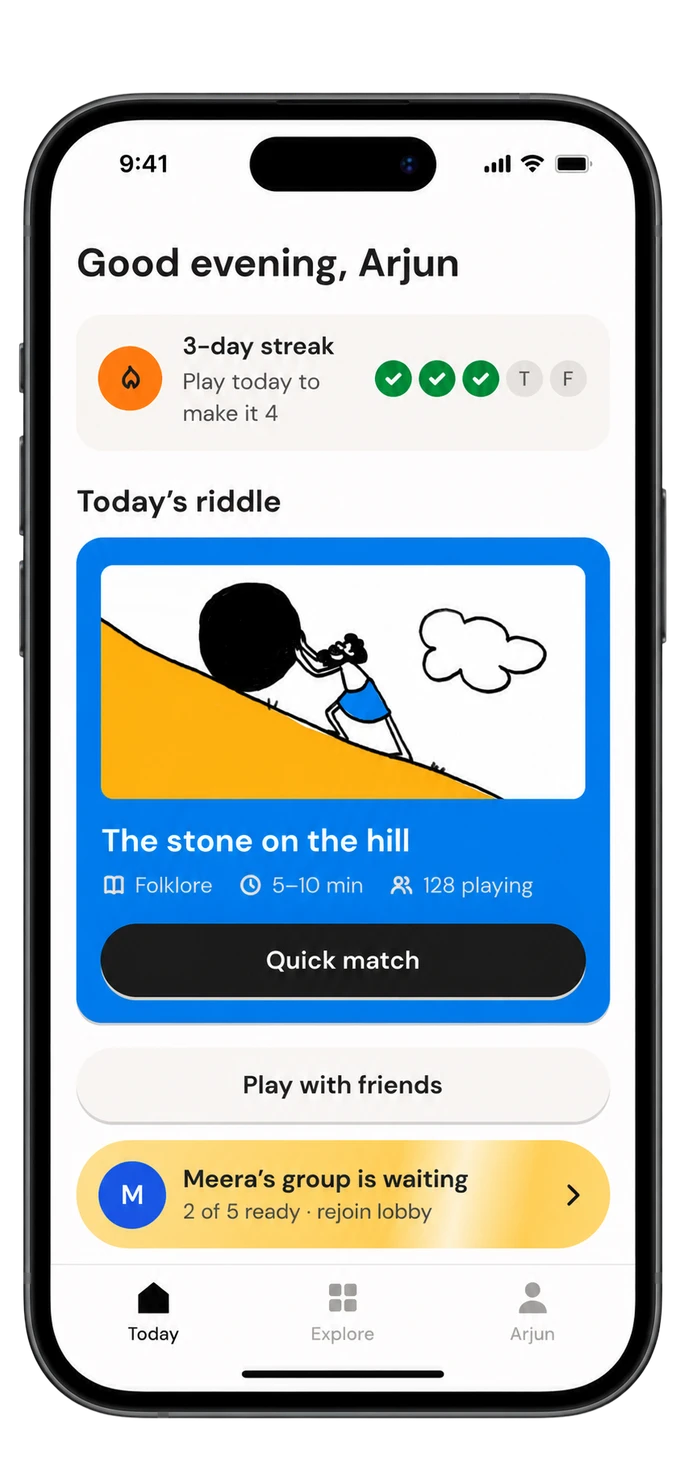
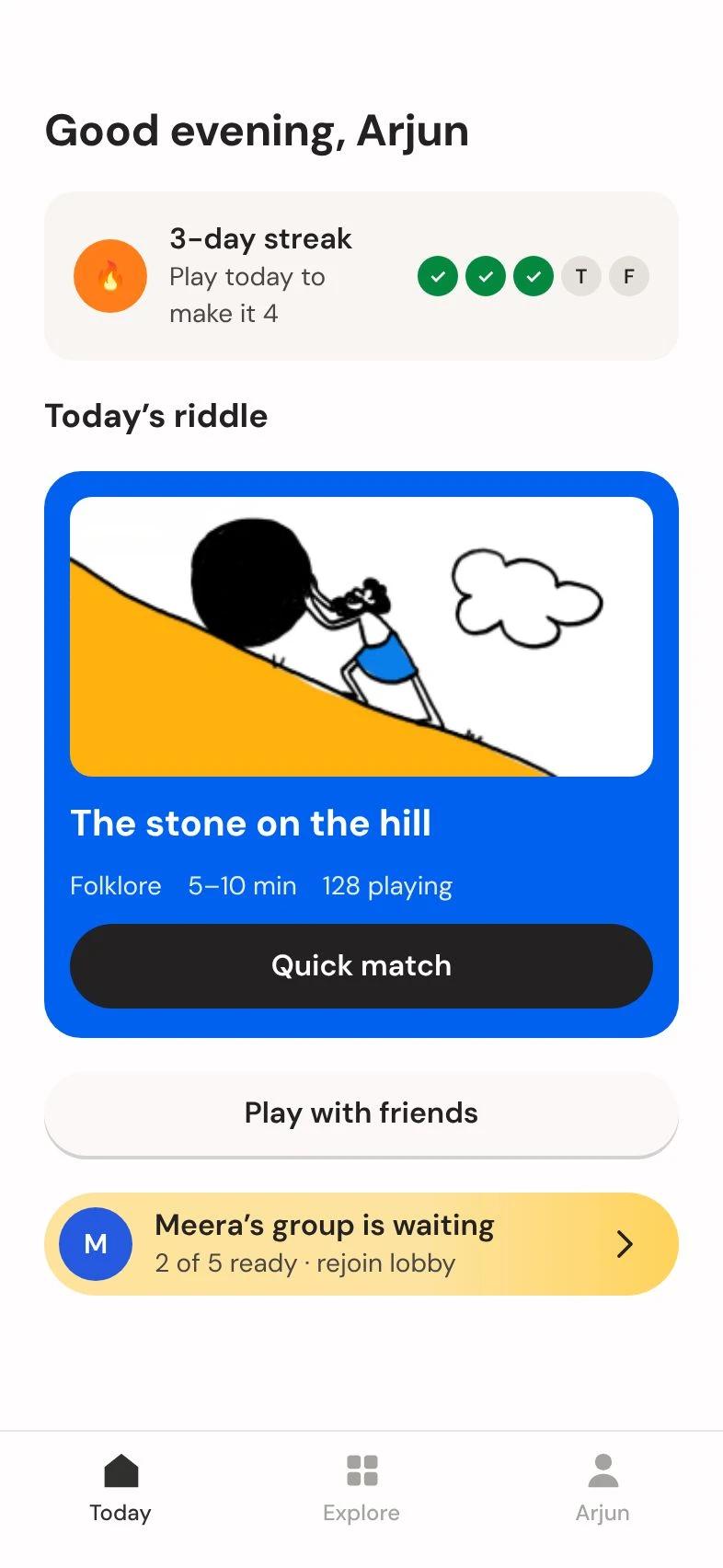
Today · Daily riddle
Keep a streak and jump into the day’s folklore puzzle with Quick Match.
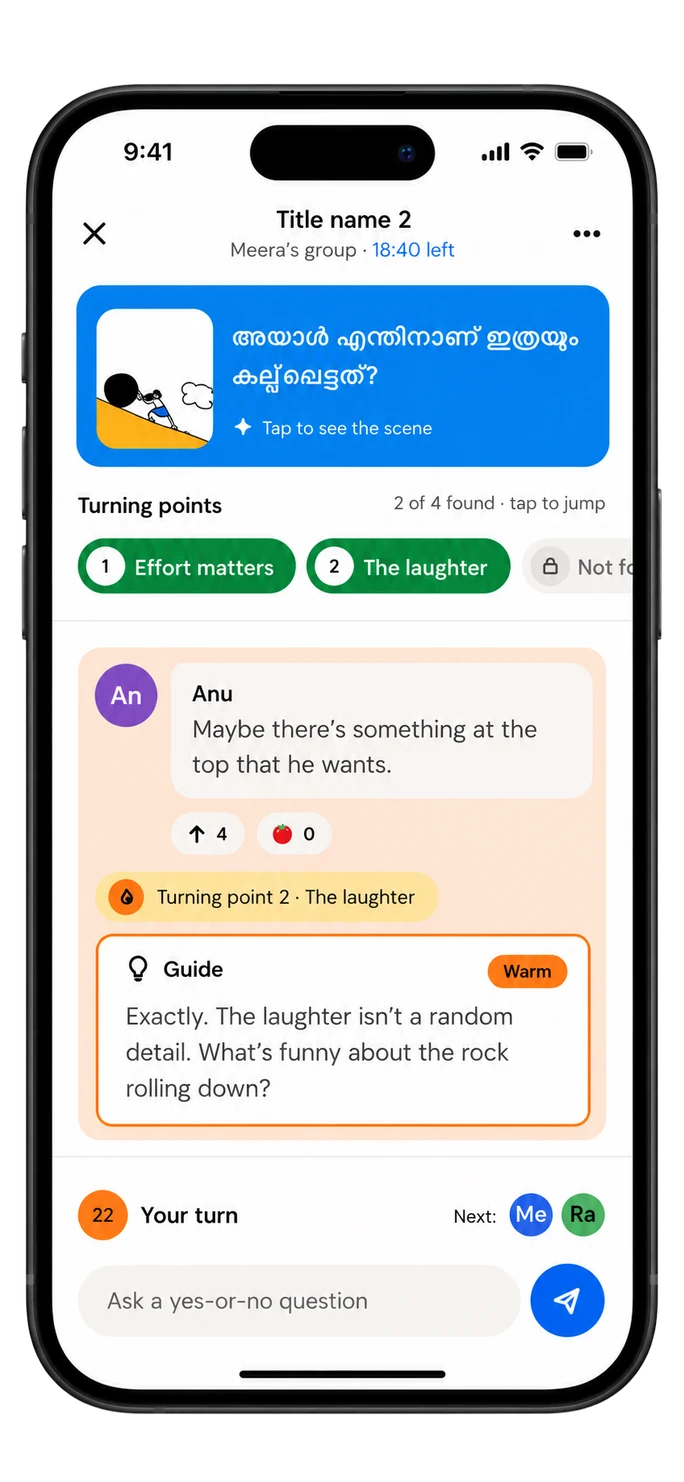
Play · Solve together
Ask yes-or-no questions while the crow tells you if you’re getting warmer.
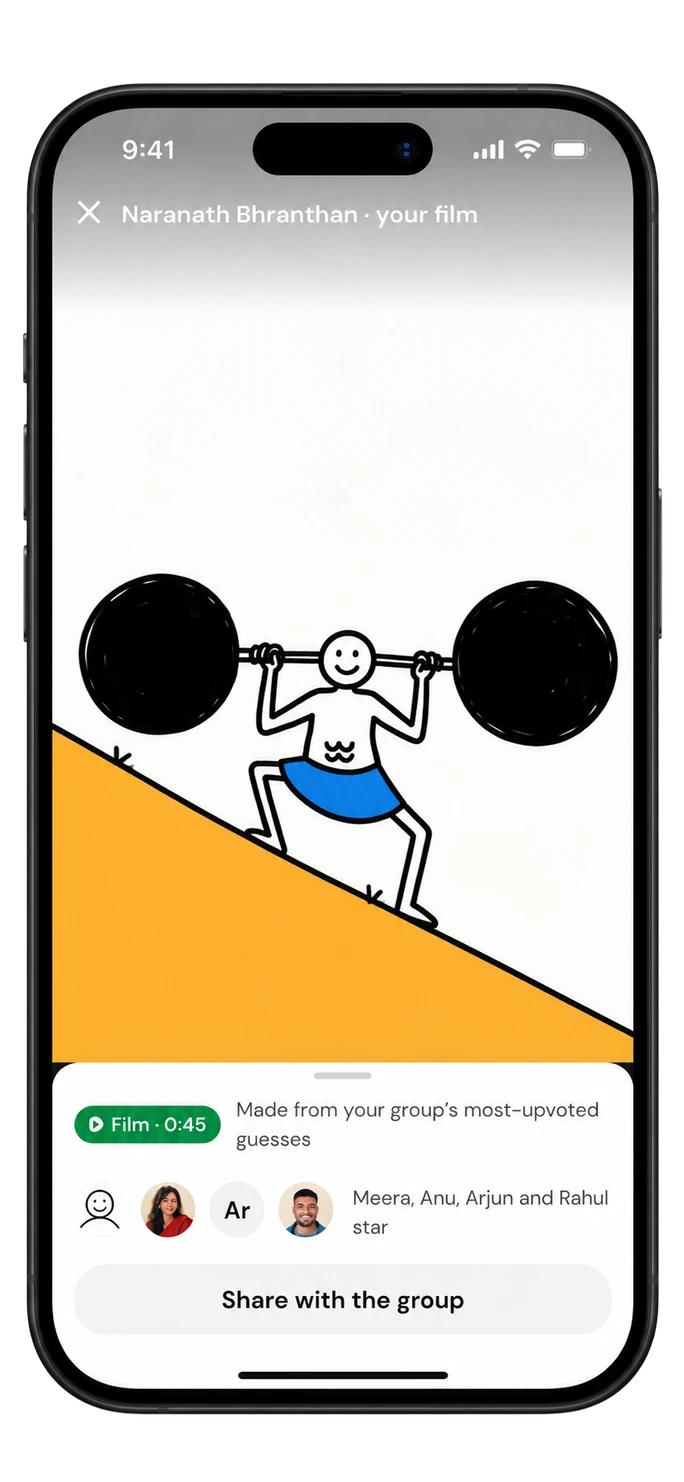
Reveal · Your story film
See the real story and star in a film made from the group’s best guesses.
The gap we found
17 of 25 students knew Sisyphus. 0 of 16 non-Malayali students had heard of Naranathu Bhranthan, and all 25 knew at most one folktale from their own state, mostly vaguely.
Context
Two men. Two stones. The same story.
Sisyphus is familiar across the world. Naranathu Bhranthan, who rolls a stone up a hill and laughs as it falls, remains a local folktale.

Sisyphus
Greek mythology
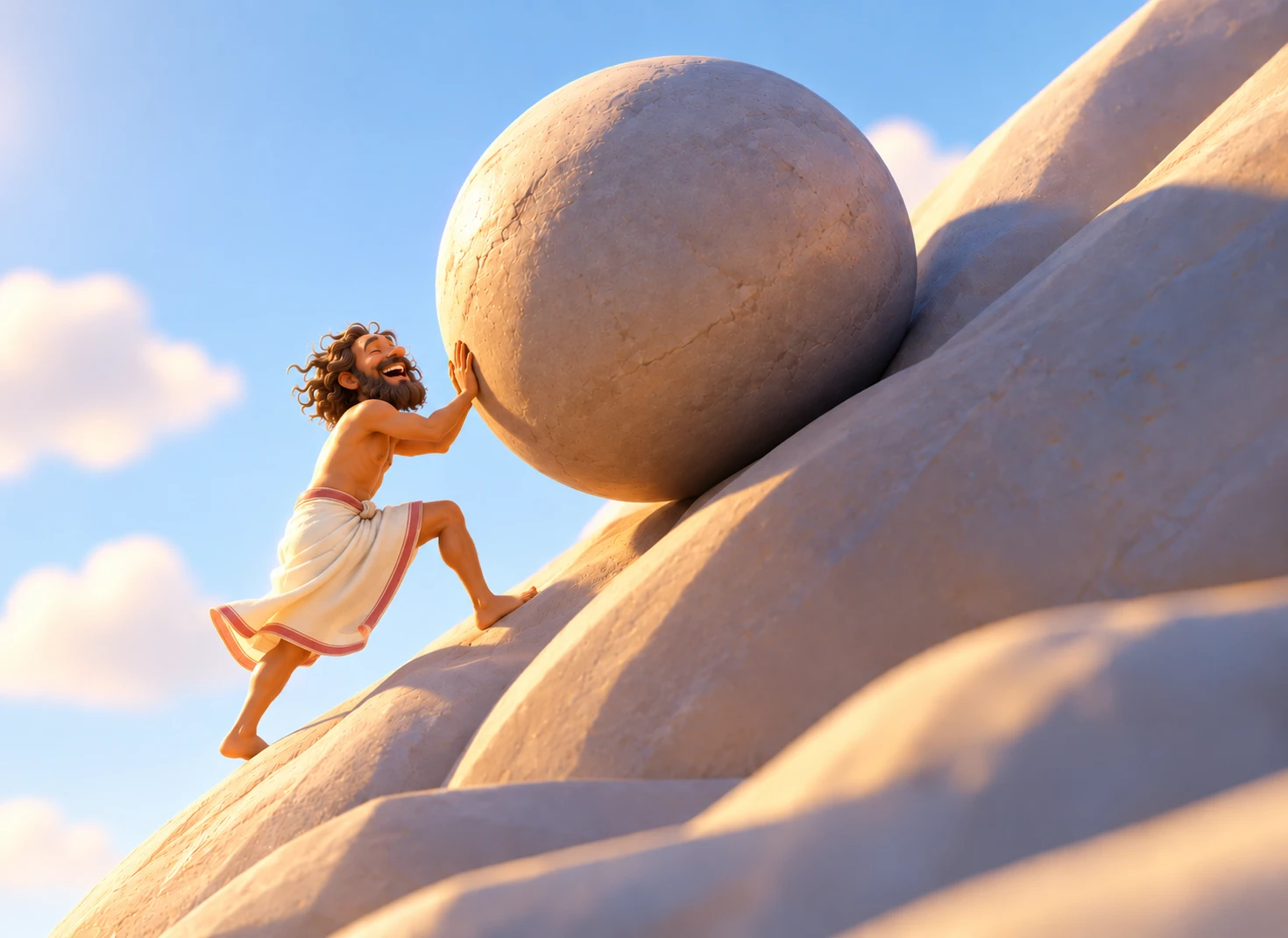
Naranathu Bhranthan
Kerala folklore
“One day in class, our professor spoke about Sisyphus, condemned to push a boulder uphill forever. We looked at each other and thought, isn’t this just Naranathu Bhranthan? A character from Kerala folklore who, too, spent his days rolling rocks uphill only to watch them tumble back down.”
Research
We asked 25 students about the folk tales they grew up with
“Have you heard of Sisyphus? What about Kerala’s Sisyphus, Naranathu Bhranthan? What about other folk stories from your state?”
17/25
knew the Greek myth of Sisyphus (68%)
0/16
non-Malayali students had heard of Naranathu Bhranthan
1/25
knew his full story; 2 remembered it vaguely
25/25
knew at most one folktale from their own state, mostly vaguely
Problem
India’s regional folk tales are slipping out of daily life. Of 25 students, 17 knew Sisyphus; only 1 could tell Kerala’s Naranath, a story with the same stone and hill.
Context
Stories once passed from grandparents in the evening. Now young people’s time lives on phones, where attention on one screen averages 47 seconds.
Opportunity
A lateral-thinking riddle game, solo or in groups, built from real tales recorded by community Story Keepers. An AI crow answers guesses; winners get a shareable film.
Insight
Why do some stories become timeless, while others slowly fade away?
Stories become timeless when they are repeated, retold, and given a reason to matter to the next generation. They survive not because they are old, but because people keep finding ways to make them relevant.
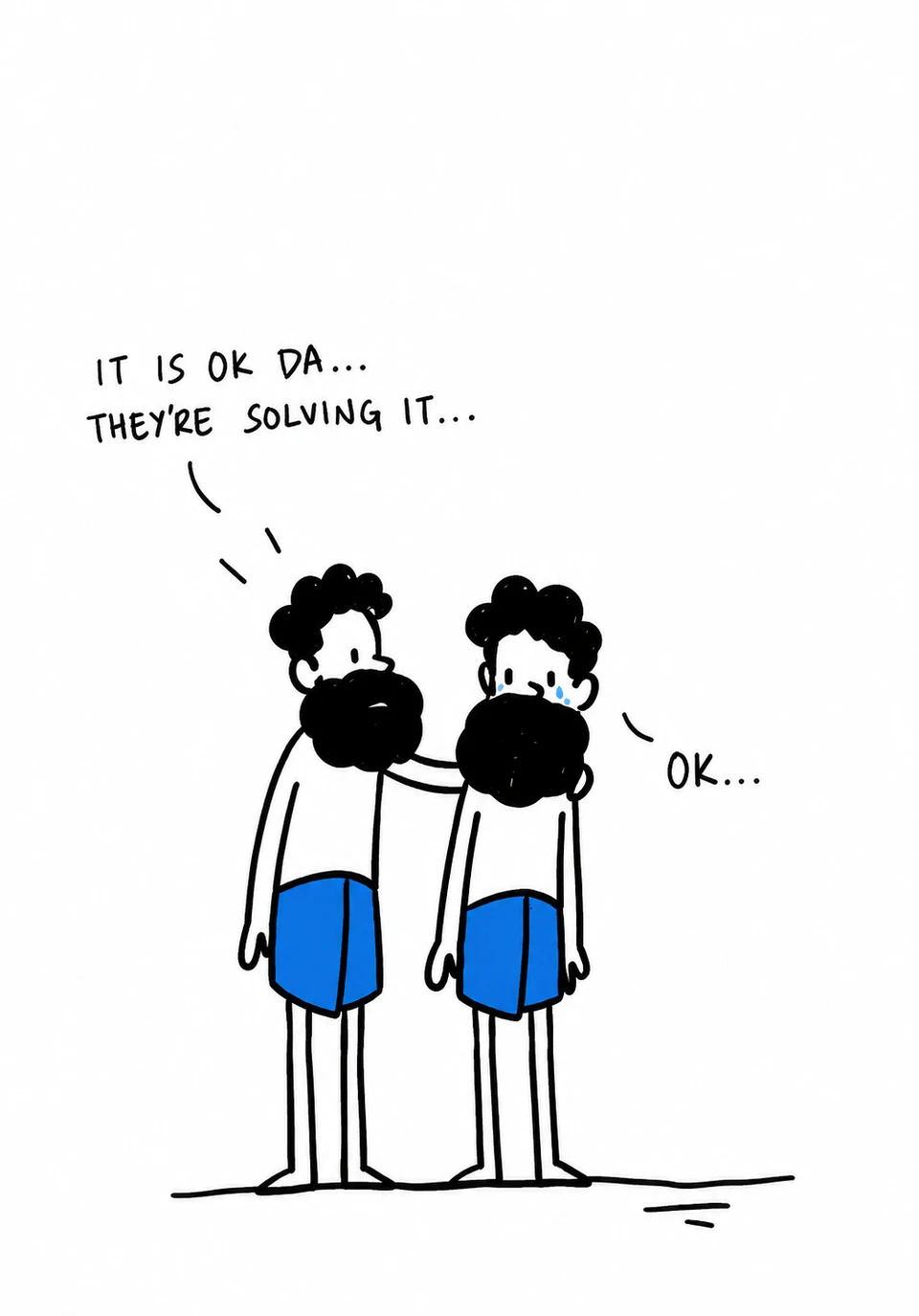
…make our forgotten folktales discoverable again, not by preserving them in books, but by turning them into something people want to solve, share, and retell?
Approach
How we approached it
The problem isn’t that people don’t care about folklore. It’s that folklore hasn’t evolved with the way people engage today.
Collecting stories
Exploring folklore and myths from different cultures

Lateral-thinking puzzles
Turning familiar stories into unexpected puzzle clues

Group interaction
Solving together through discussion, debate and discovery

Shareable content
Making folklore engaging enough to pass from one person to another
Mechanic
Lateral thinking + riddle = engaging
Why? Because a riddle is the opposite of a scroll.
It holds attention
You can’t swipe past a riddle. A round asks you to stay with one question for ten minutes.
The “aha” is a real reward
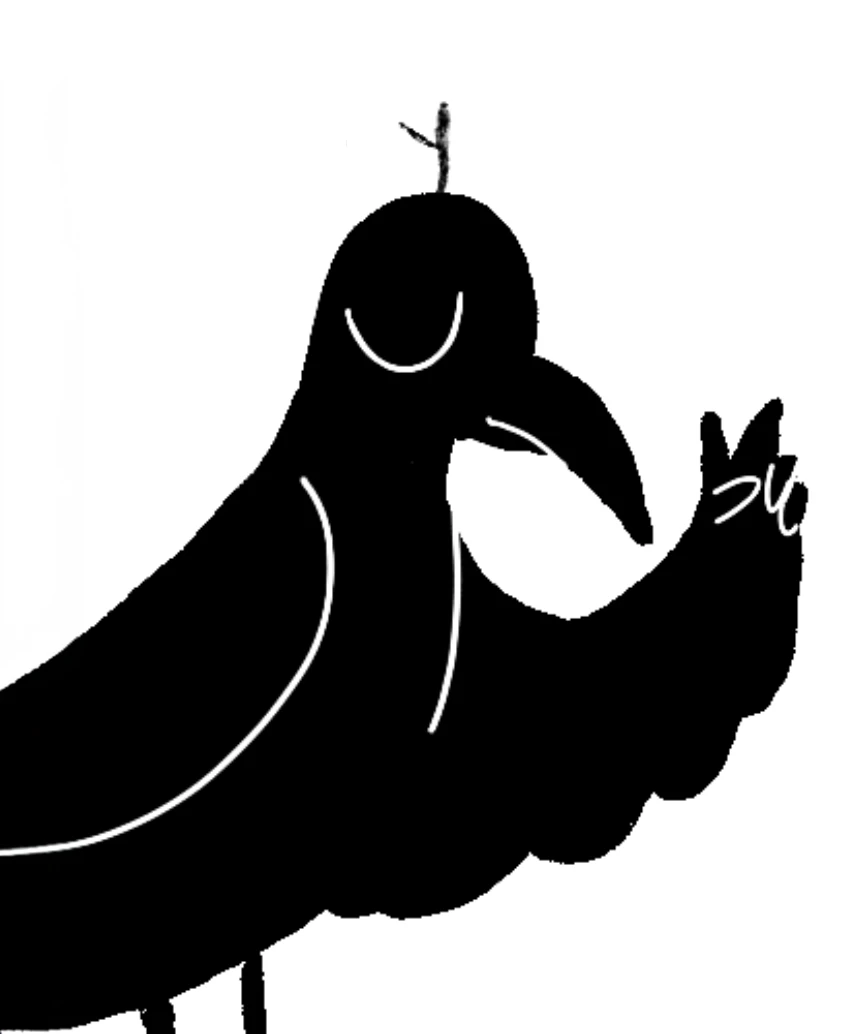
Why a crow
India’s oldest messenger
Across India the crow carries messages: fed during Shraddha as a link to the ancestors, its “kaa kaa” on the parapet said to announce guests, and remembered as the clever bird that dropped pebbles into the pot.
Sad that you even asked that question but ok..
Our crow does the same job. It carries stories between generations, and it is clever enough to give you only hints.
The app
One riddle, five people, and a crow that only gives hints
Onboarding teaches a round with a live example. After that, every day brings one folktale riddle, a language-matched group to solve it with, and a short film of the group’s best guesses when it’s cracked.
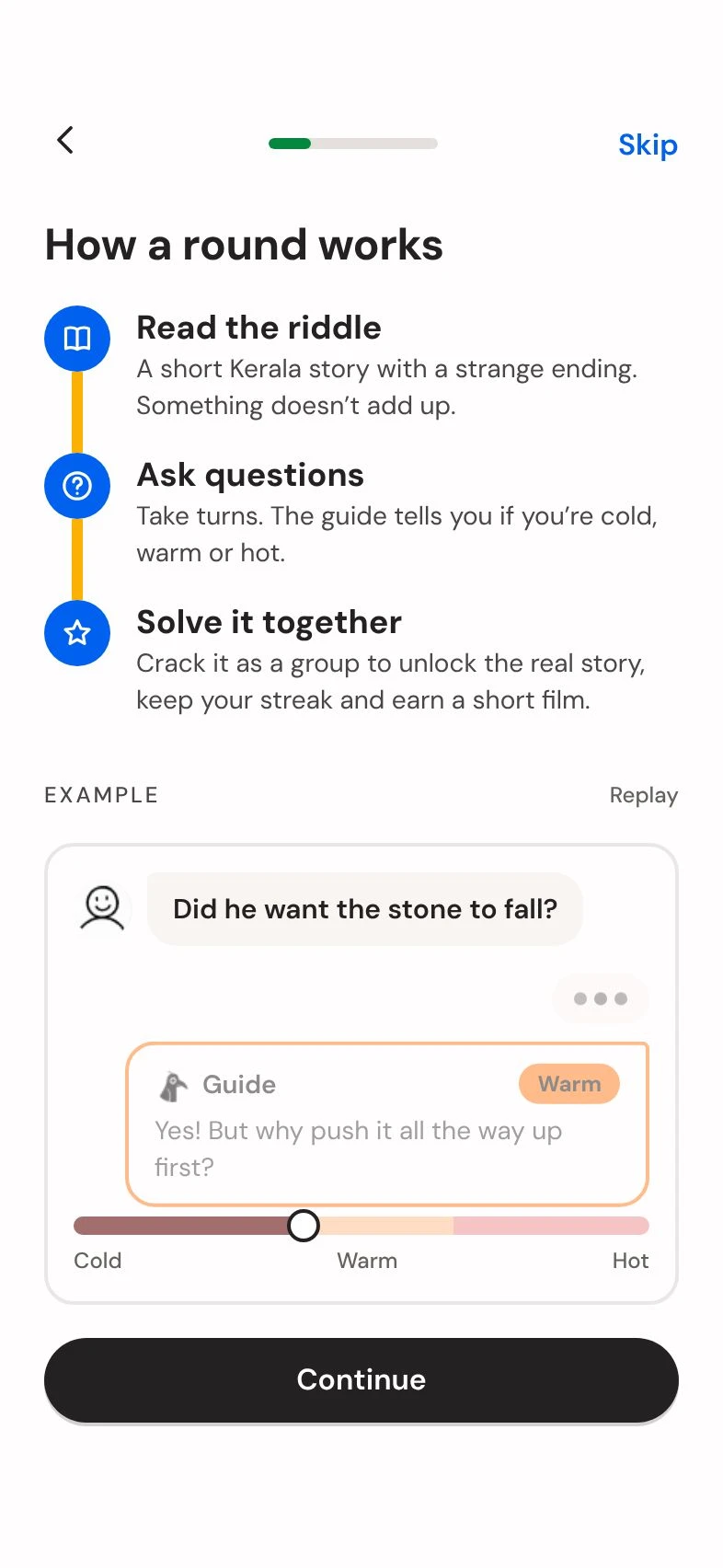
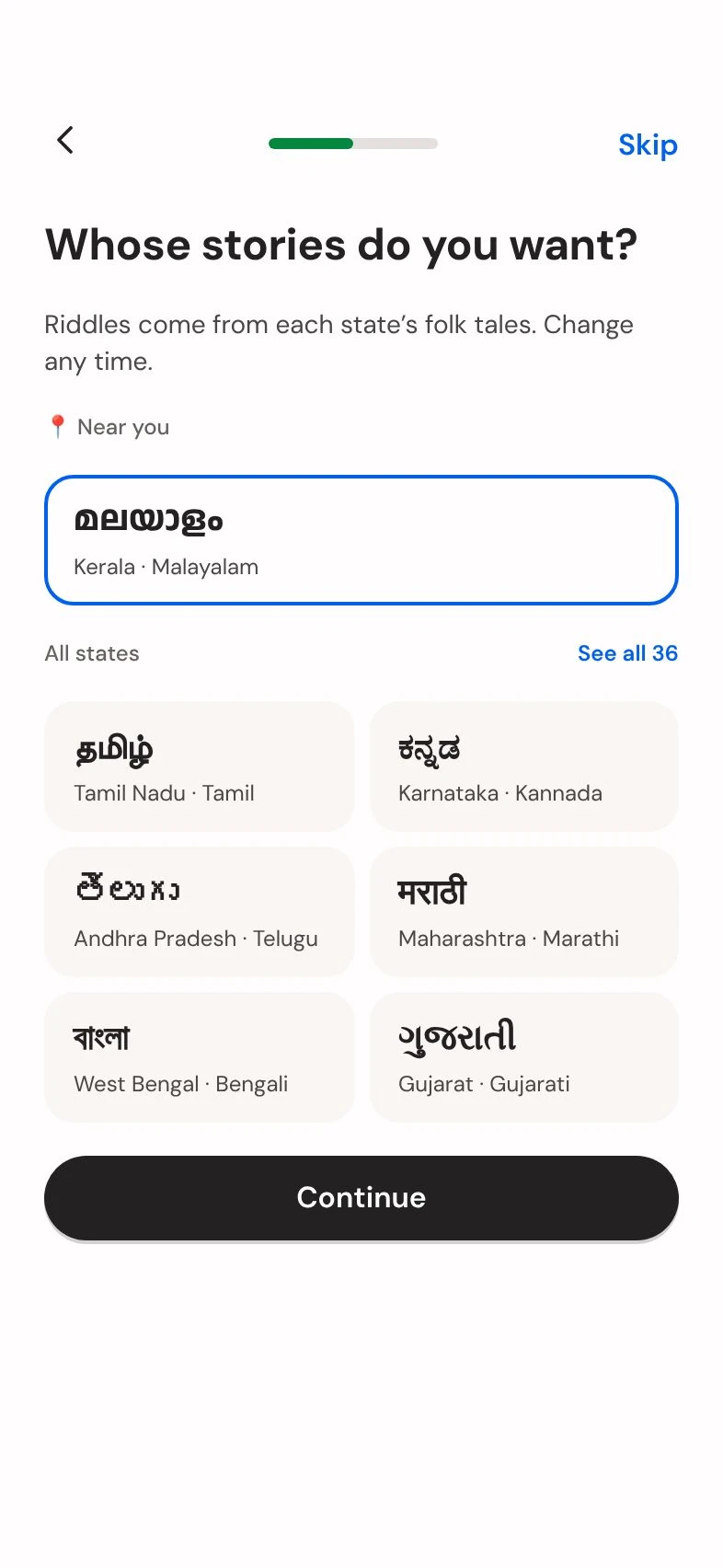
Learn the game in one example.Then choose whose stories you want.
A three-step explainer plays a real round: a guess, the Guide’s reply, and a meter that moves from cold to hot. Players then pick a state and how riddles should read, in their language, English, or both side by side.
One riddle a day.Five people to solve it with.
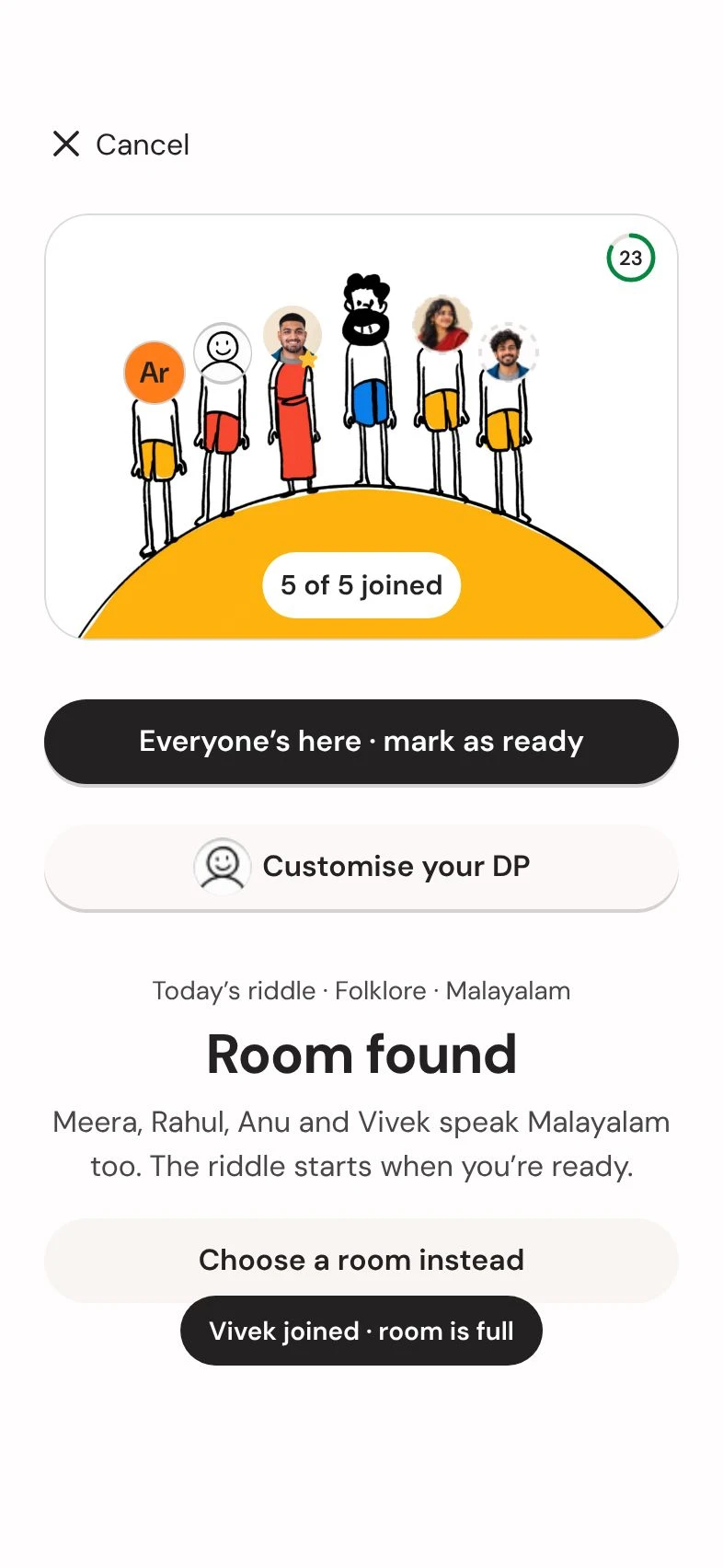
Today shows the streak and the day’s riddle. Quick match finds four other players who speak the same language, with a live count, a countdown and one Ready button.
Ask, guess, get warmer.The crow only gives hints.
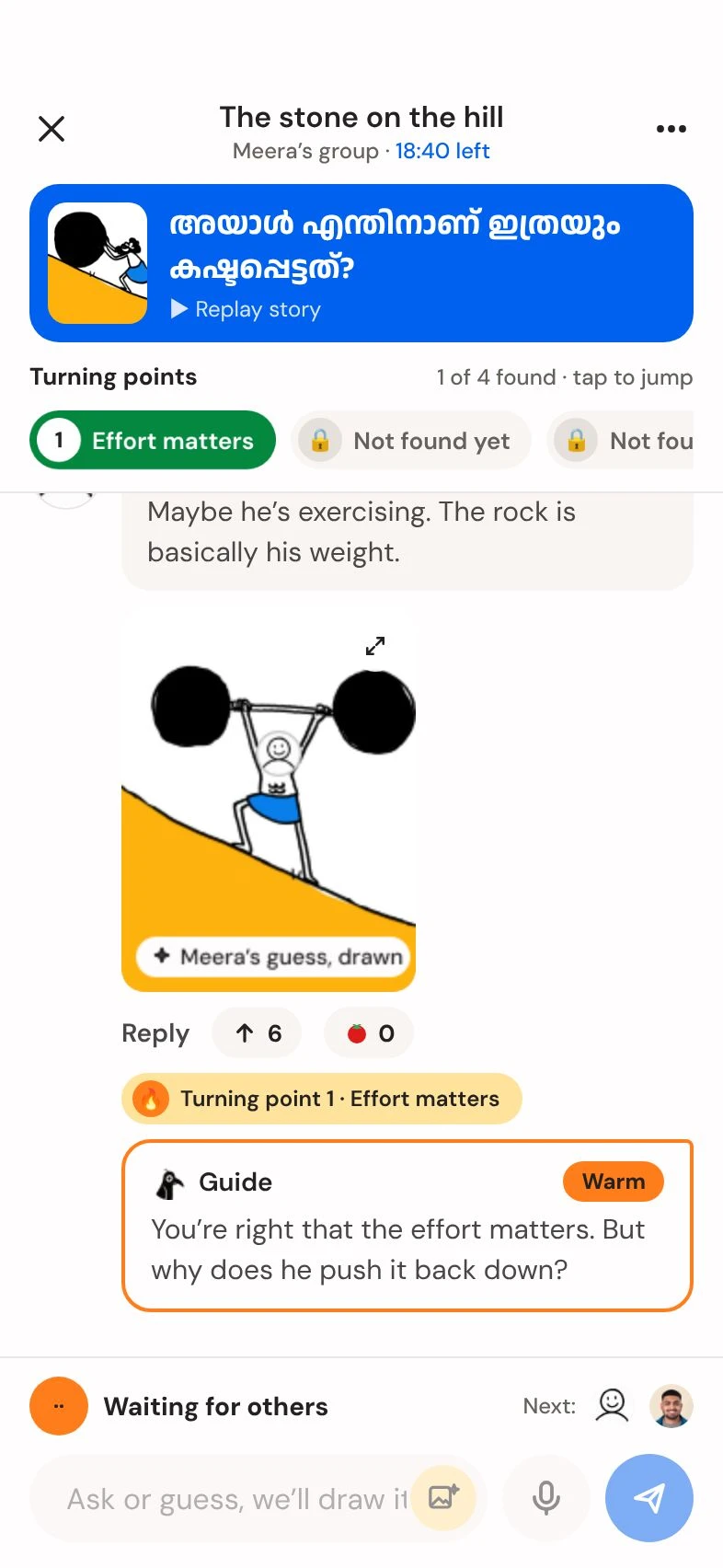
Players take turns asking yes-or-no questions. Every guess is drawn as a doodle, the Guide answers cold, warm or hot, and turning points unlock as the group closes in.
Crack it, read the real story.Then star in the film.
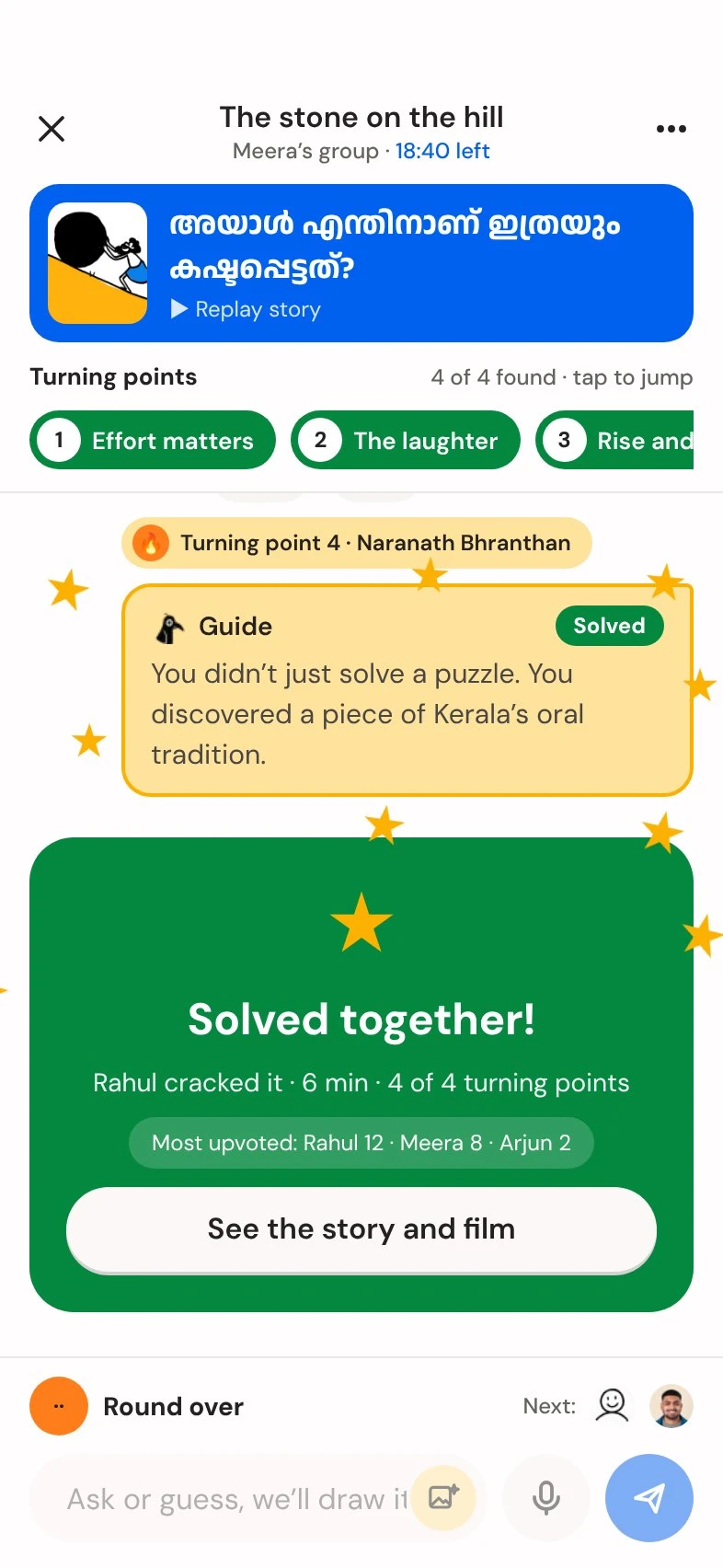
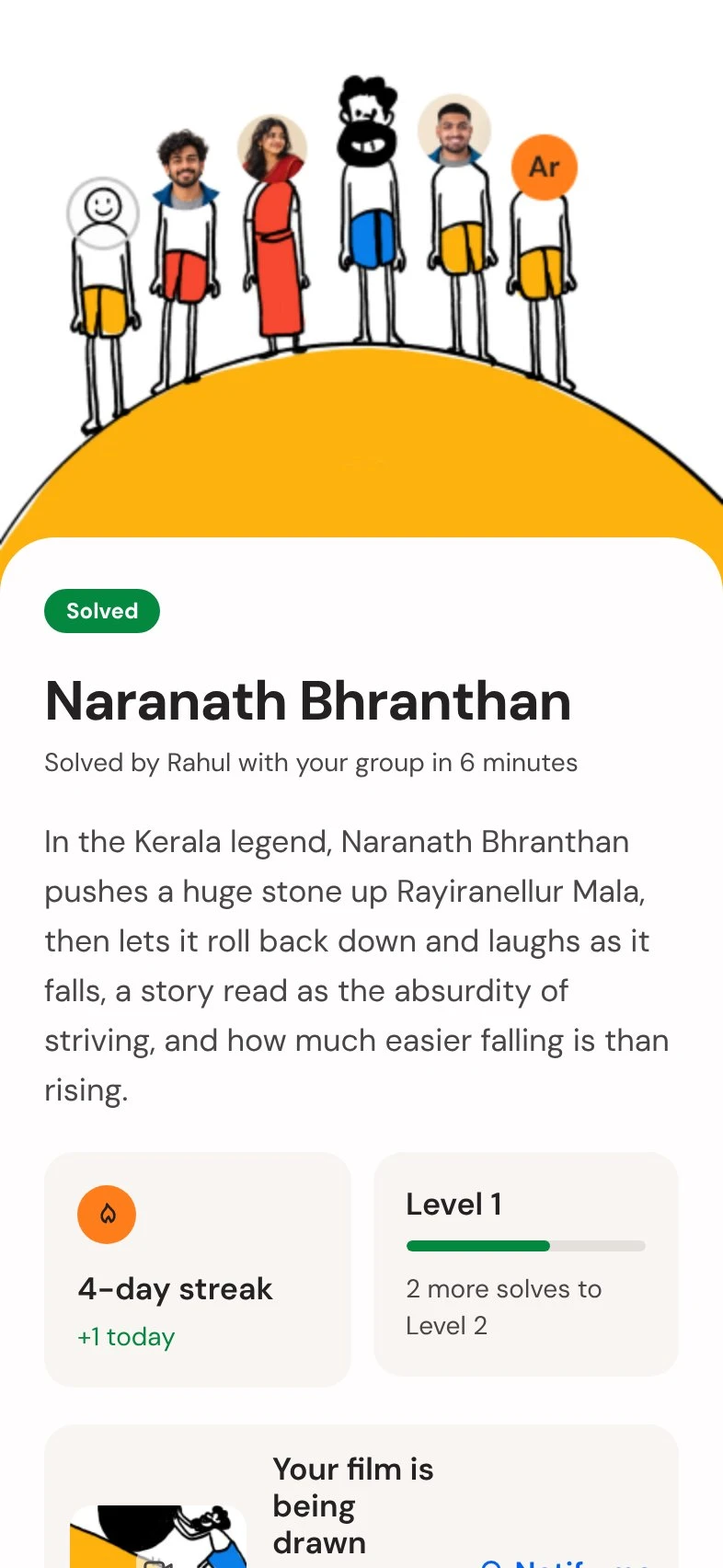
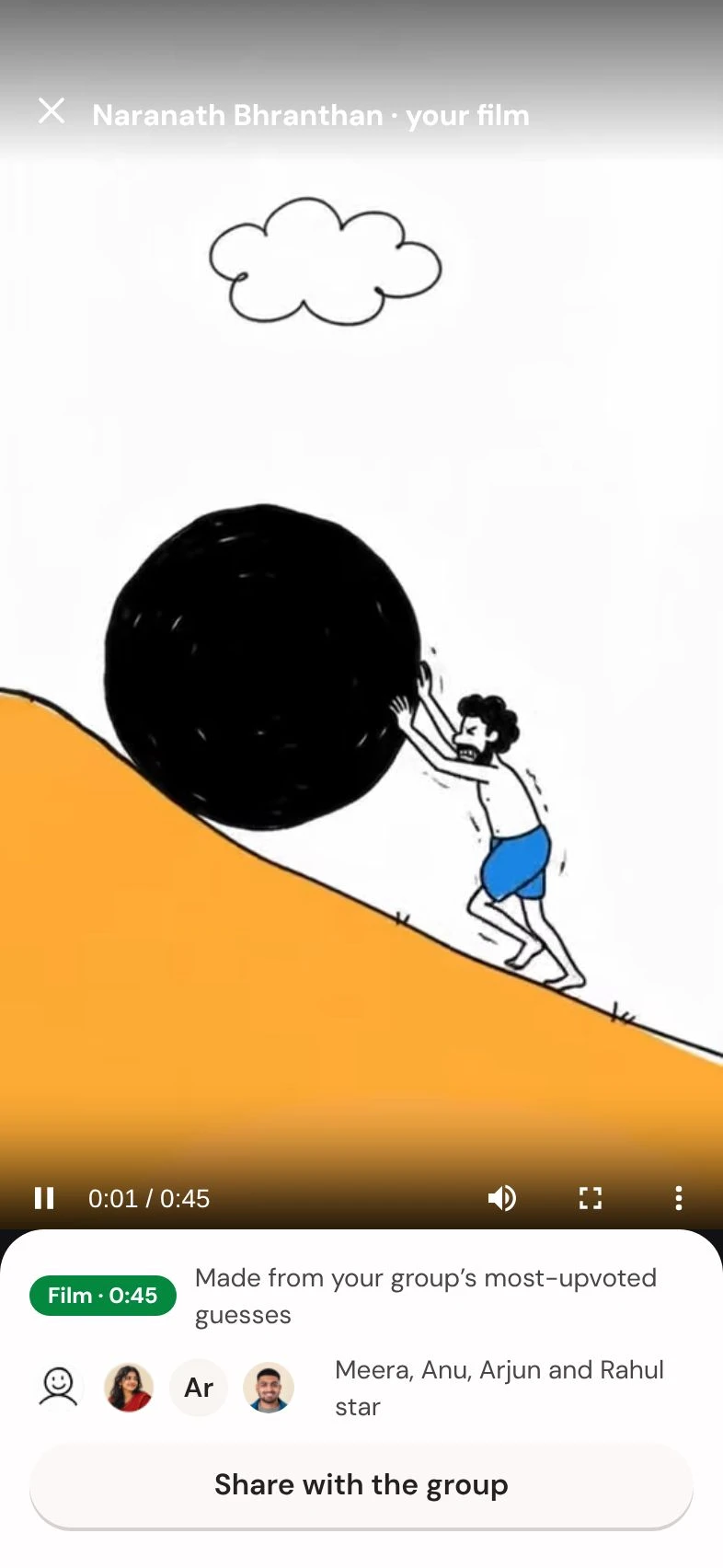
The solve reveals the folktale behind the riddle and keeps the streak going. The group’s most-upvoted guesses become a 45-second film with the players drawn into the scene.
Your doodle in chat.Your face in the film.
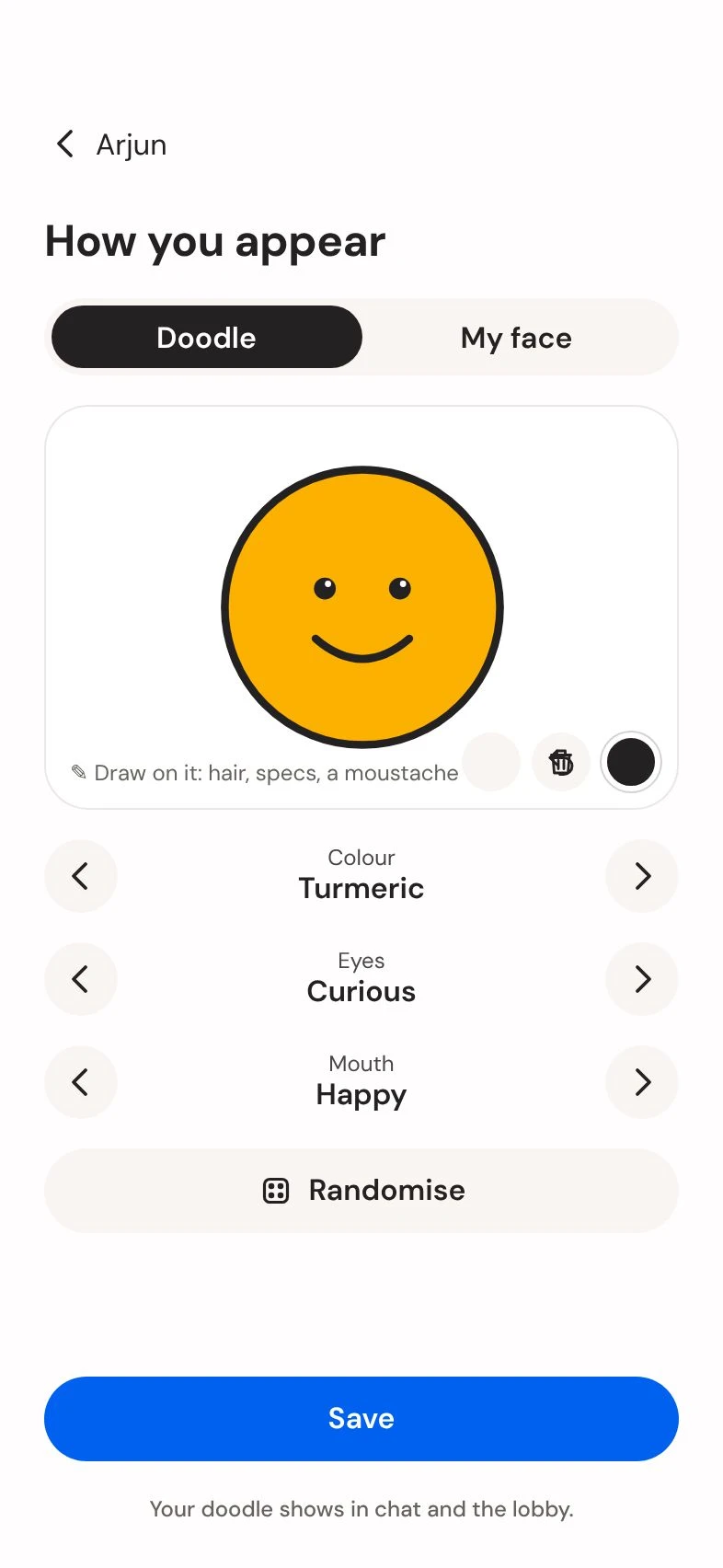
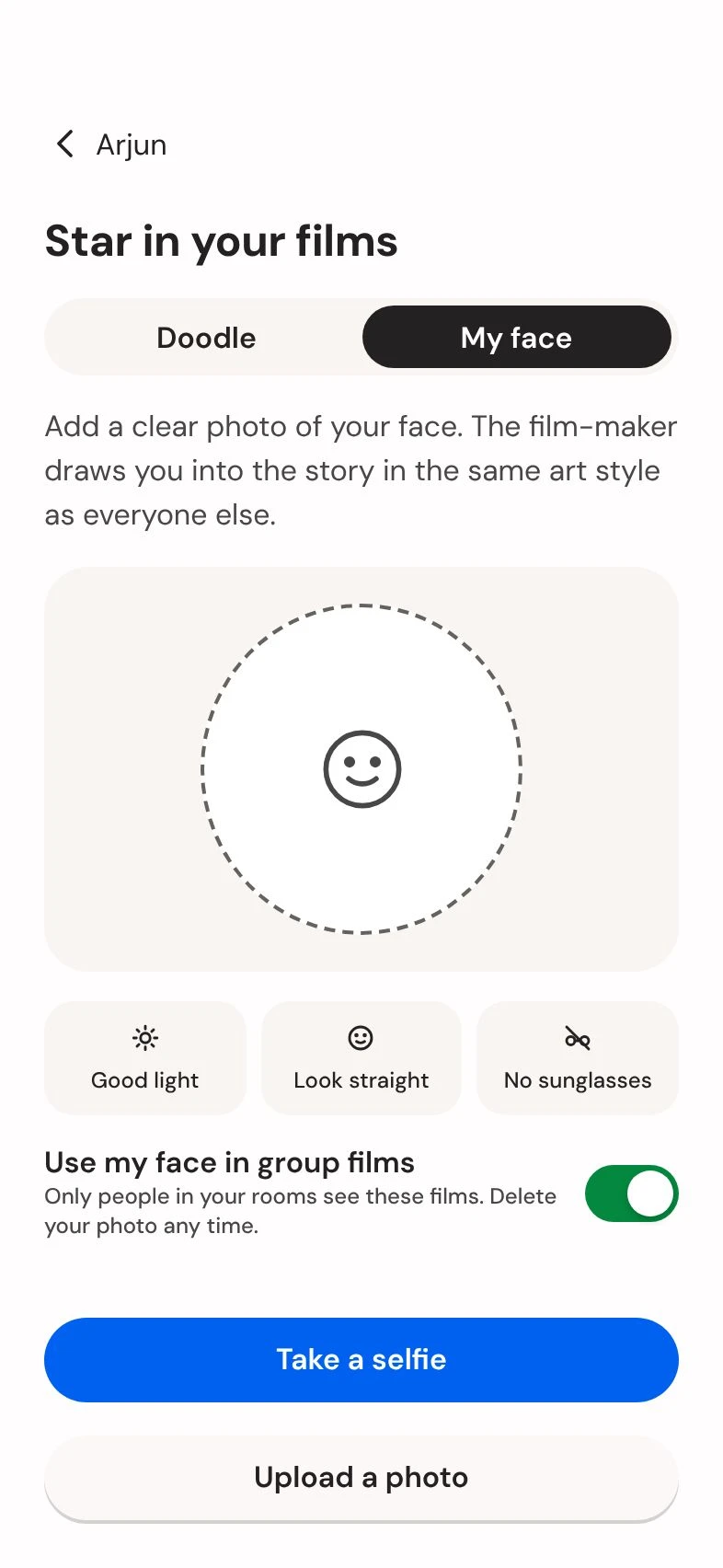
Players design a doodle avatar that appears in chat and the lobby, and can add a selfie so the film-maker draws them into the story. Faces are only used to draw, and can be deleted any time.
Always a room to join.Always a story to explore.
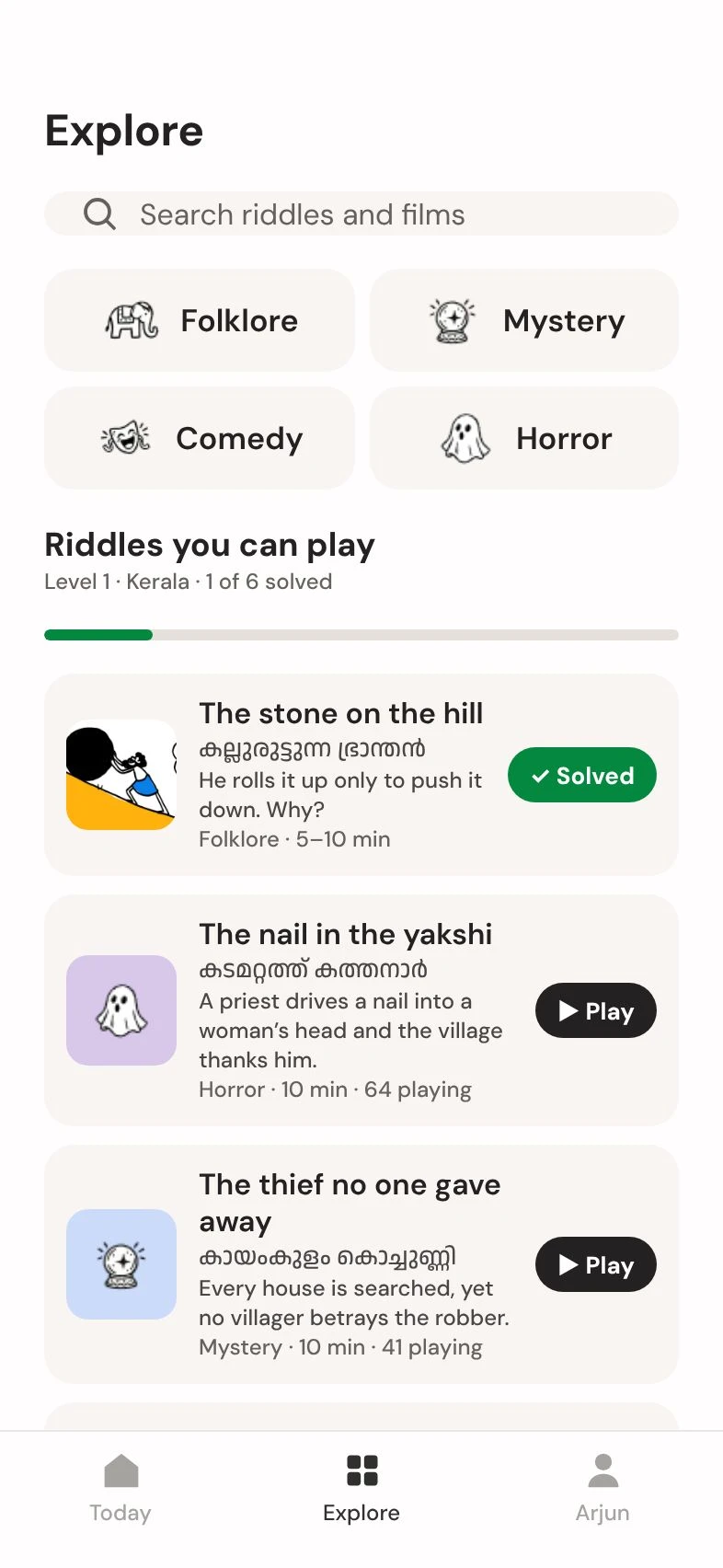
Explore groups riddles by genre and level, with rooms that are about to start and films unlocked from past solves. Rooms are sorted by how soon the round begins.
Impact
Three relationships, strengthened
Crow & Co is built around play that happens between people, not just on a screen.
Friend ↔ Friend
Shared play: a round to solve and a film to send.
Child ↔ Elder
A story collection you can pass on to the next generation.
Person ↔ Culture
Identity and belonging, through stories from home.
Precedents
Heritage games exist. None turn local tales into thinking play.
What each precedent proves, where it stops, and what we borrowed from it.
| Precedent | What it proves | Where it stops | What we borrow |
|---|---|---|---|
| Never Alone (2014) | Made with 40 Alaska Native elders and storytellers; won a BAFTA | One story, a console game | Elders as credited co-authors |
| Raji (2020) | Pune-made; first Indian game nominated at The Game Awards | Pan-Indian epics; action, not thinking | Regional art styles as the look |
| Wordle (2021) | A daily puzzle can reach millions through a share card | No story or culture inside | The daily ritual and the share |
Evaluation
How Crow & Co measures up
Impact
Keeps regional stories in daily use and circulating online

Innovation
Folklore as lateral riddles, judged by an AI that reads open guesses

Accessible
Voice-first, multilingual, works on basic phones

Utility
A ready activity for parties, classrooms, family calls, or alone
Reality of production
Built on existing speech, language and video models

Emotional quotient
The “aha” of cracking it, a win to share, a story from home
Our vision
Imagine an India where every district has its stories preserved, every family can contribute folklore, and every child discovers culture through curiosity.
Reflection
A story only survives if someone wants to tell it again
We started by asking how to preserve folklore and ended up asking why anyone would retell it. That shift moved the design away from an archive and towards play: a riddle that holds attention, a guide that only hints, and a film the group wants to share. The entry wasn’t shortlisted at Design Days, and looking back, the weakest link is where the stories come from. Next, we want to work with Story Keepers to source tales responsibly, and playtest a round with students and their grandparents to see if the game actually starts conversations between generations.
References
- Primary: conversations with 25 students, NID Bengaluru, Sept–Oct 2026
- Boloji, “Naranath Bhranthan: Sisyphus minus his curse”; Onmanorama (2018)
- Albert Camus, The Myth of Sisyphus (1942)
- People’s Linguistic Survey of India (2010–2013)
- UNESCO, Atlas of the World’s Languages in Danger (2010)
- ASER Centre, ASER 2024
- ORF, “Students, Screens and Human Capital Formation in India” (2025)
- Gloria Mark, Attention Span (2023)
- Oxford University Press, Word of the Year 2024
- Edward de Bono, The Use of Lateral Thinking (1967)
- Oh et al., NeuroImage (2020): insight reward signal
- Danek et al., Psychological Research (2013): insight and memory
- Brooker, Corbett et al., Int. J. Geriatric Psychiatry (2019): PROTECT
- OECD, PISA 2022 Results Vol. III (2024)
- World Economic Forum, Future of Jobs Report (2025)
- Never Alone (2014); Raji: An Ancient Epic (2020); Wordle (2021)